

Victoria Falls
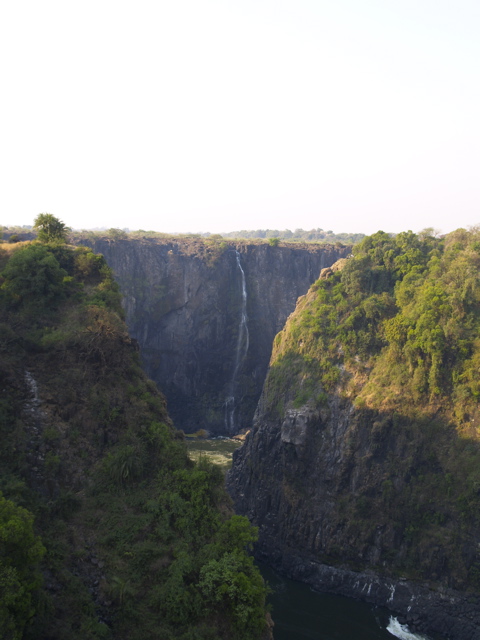
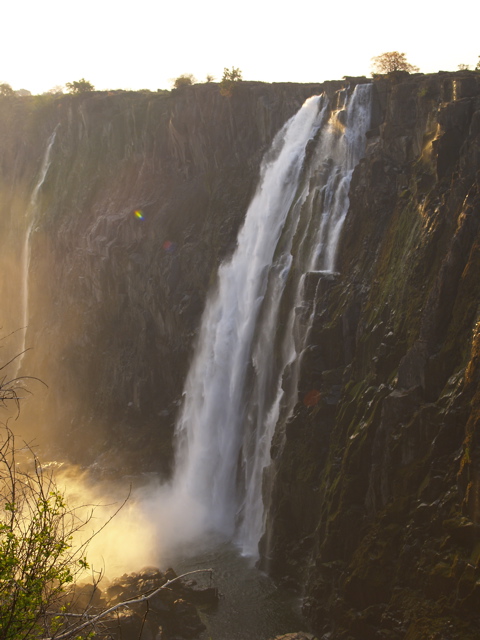
We proceeded next morning, 9th August 1860, to see the Victoria Falls. Mosi-oa-tunya is the Mokololo name, and means smoke sounding; Seongo or Chongwe, meaning the Rainbow, or place of the Rainbow, was the more ancient term they bore.
[...]
It is rather a hopeless task to endeavour to convey an idea of it in words, since, as was remarked on the spot, an accomplished painter, even by a number of views, could but impart a faint impression of the glorious scene. The probable mode of its formation may perhaps help to the conception of its peculiar shape. [...] [T]he Victoria Falls have been formed by a crack right across the river, in the hard, black, basaltic rock which there formed the bed of the Zambesi.
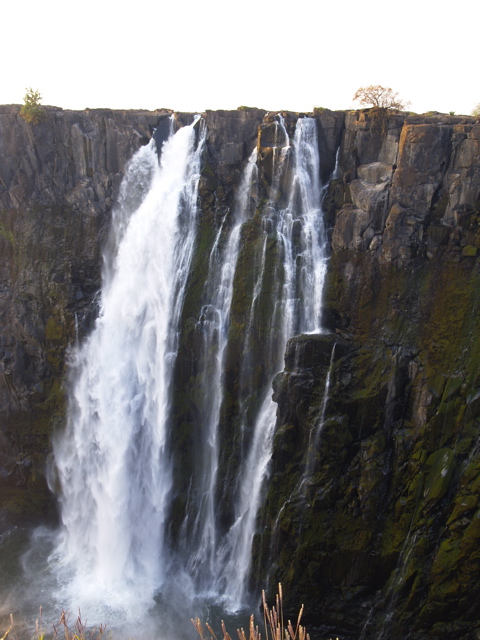
The lips of the crack are still quite sharp, save about three feet of the edge over which the river rolls. The walls go sheer down from the lips without any projecting crag, or symptom of stratification or dislocation. When the mighty rift occurred, no change of level took place in the two beds of the river thus asunder, consequently, in coming down the river to Garden Island, the water suddenly disappears, and we see the opposite side of the cleft, with grass and trees growing where once the river ran, on the same level as that part of its bed on which we sail. The first crack is, in length, a few yards more than the breadth of the Zambesi, which by measurement we found to be a little over 1860 yards, but this number we resolved to retain as indicating the year in which the Fall was for the first time carefully examined.
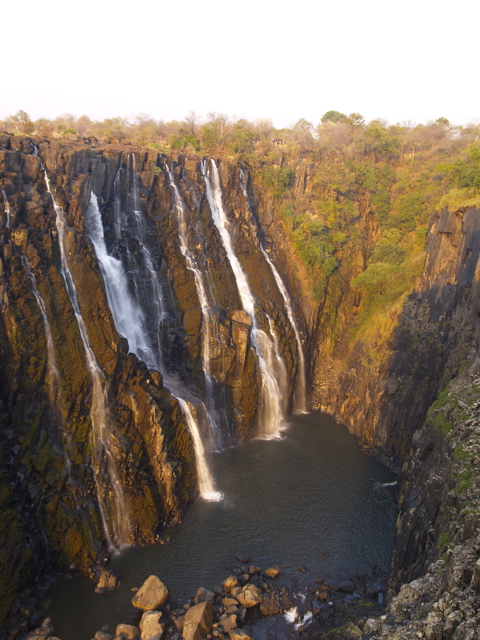
The main stream here runs nearly north and south, and the cleft across it is nearly east and west. The depth of the rift was measured by lowering a line, to the end of which a few bullets and a foot of white cotton cloth were tied. One of us lay with his head on a projecting crag, and watched the descending calico, till, after his companions had paid out 310 feet, the weight rested on a sloping projection, probably 50 feet from the water below, the actual bottom being still further down. The white cloth now appeared the size of a crown-piece. On measuring the width of this deep cleft by sextant, it was found at Garden Island, its narrowest part, to be eighty yards, and at its broadest somewhat more. Into this chasm, of twice the depth of Niagara-fall, the river, a full mile wide, rolls with a deafening roar; and this is Mosi-oa-tunya or the Victoria Falls.